Sources and what they would read
What each external system is designed to read, and where to see what is actually connected.
On this page
Where this comes from
This guide is distilled from docs/GROWTH-INTEGRATIONS.md and src/features/growth-kit/connections/registry.ts. When the guide and Growth-OS disagree, that document is the one to trust, and the difference is worth reporting.
One owner per kind of truth
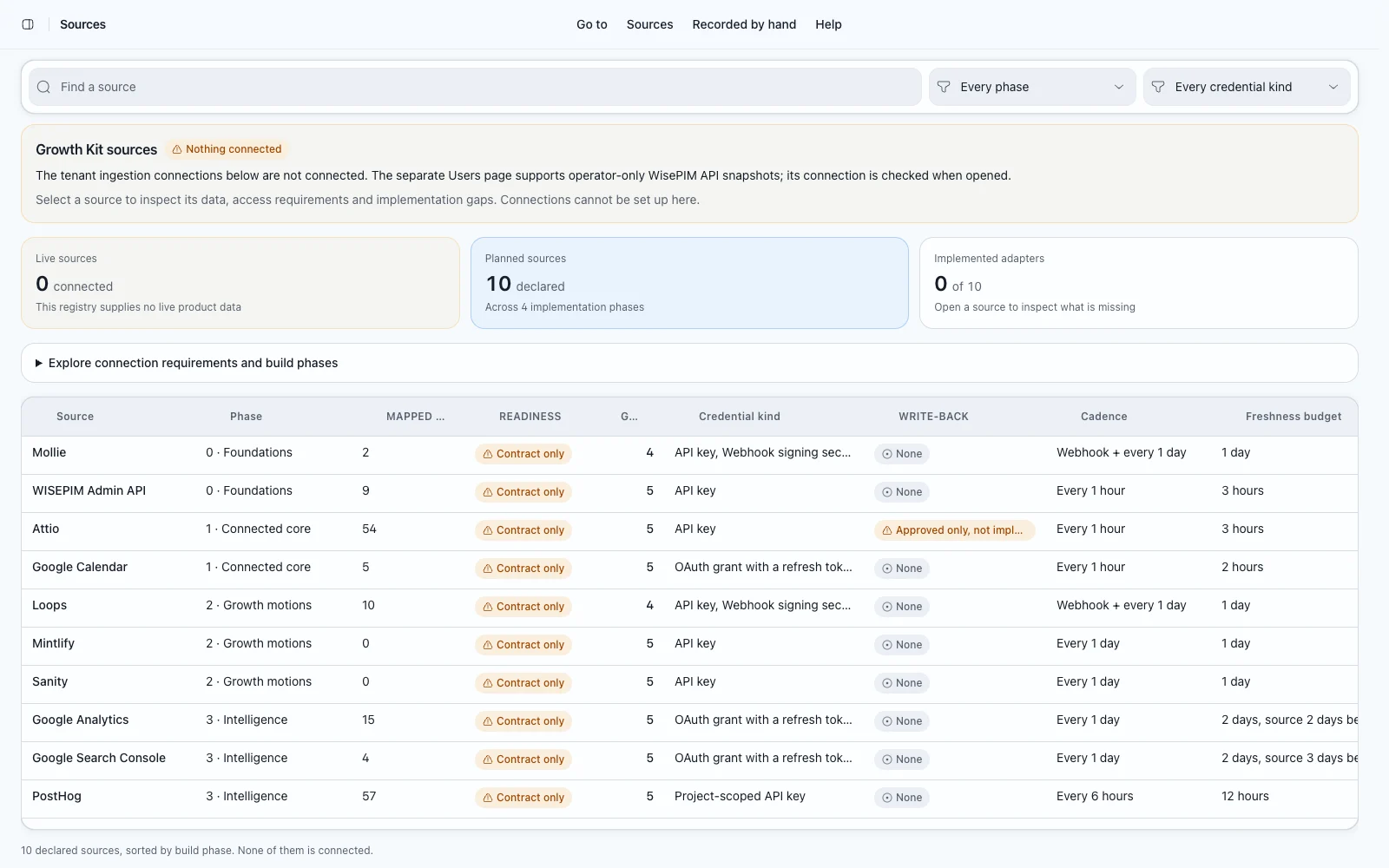
Fifteen sources are declared, each as the owner of one kind of truth. Attio would own the customer relationship record. Granola would own meeting notes, summaries and transcripts. PostHog would own product behaviour. Mollie would own customer payments and subscription movements. Google Analytics and Search Console would own traffic and search. Loops would own email delivery and response. Sanity and Mintlify would own published content and documentation. Google Calendar would own when meetings happened and who attended. Airscale, SerpAPI, Firehose and Firecrawl would own outward-facing prospecting and crawling, and the WISEPIM admin API would own the product account.
One owner per metric is the point. The rest cross-check it rather than each producing their own version of the same number.
Read the page before you quote a number
Every source card states the same facts in the same order: the truth that system owns, what Growth-OS would read from it, what it may write back and under which approval, how often it would read, the freshness budget, the credential it would need, where that credential lives, and the server boundary that authorizes the read.
The card also carries what is still missing for that source, which is what makes this page a work list rather than an aspiration. The Sources page is the only honest answer to the question of whether a figure is live, so check it there rather than assuming.
Connecting one
Connecting a source happens on its own card, and what you supply is a credential the server encrypts, versions and revokes. No credential is ever displayed back, and there is nowhere in Growth-OS that shows you a key you pasted.
A source that needs a site, property, project or dataset chosen and has none refuses the read. There is no fallback value anywhere in that path, and that is deliberate: a default there means a misconfigured deployment reads somebody else's data instead of stopping.
What a connection does not change
A connected source reads. It does not turn a Growth-OS record into a mirror of an external system, and it does not write our edits outward unless the card says so and the approval it names has been given.
Records you edit here stay edited. The Attio record ID on a company, for example, is a field you type so a person can find the same company over there.
Was this page helpful?
Feedback is stored only in this browser in the starter implementation.