Why every insight in Growth-OS carries its quote
The exact-quote rule, how meeting intelligence proposes observations that a person approves, and the explorer that opens the transcript behind every count.
WISEPIM Growth-OS
Product
A count nobody can open is a rumour
We have all sat in a review where somebody says pricing keeps coming up. Nobody argues, because nobody can check. The claim started as a memory of a call, became a line in a personal document, and arrived on a slide with the conversation stripped out of it. By then it is impossible to tell whether four customers said it or one said it four times.
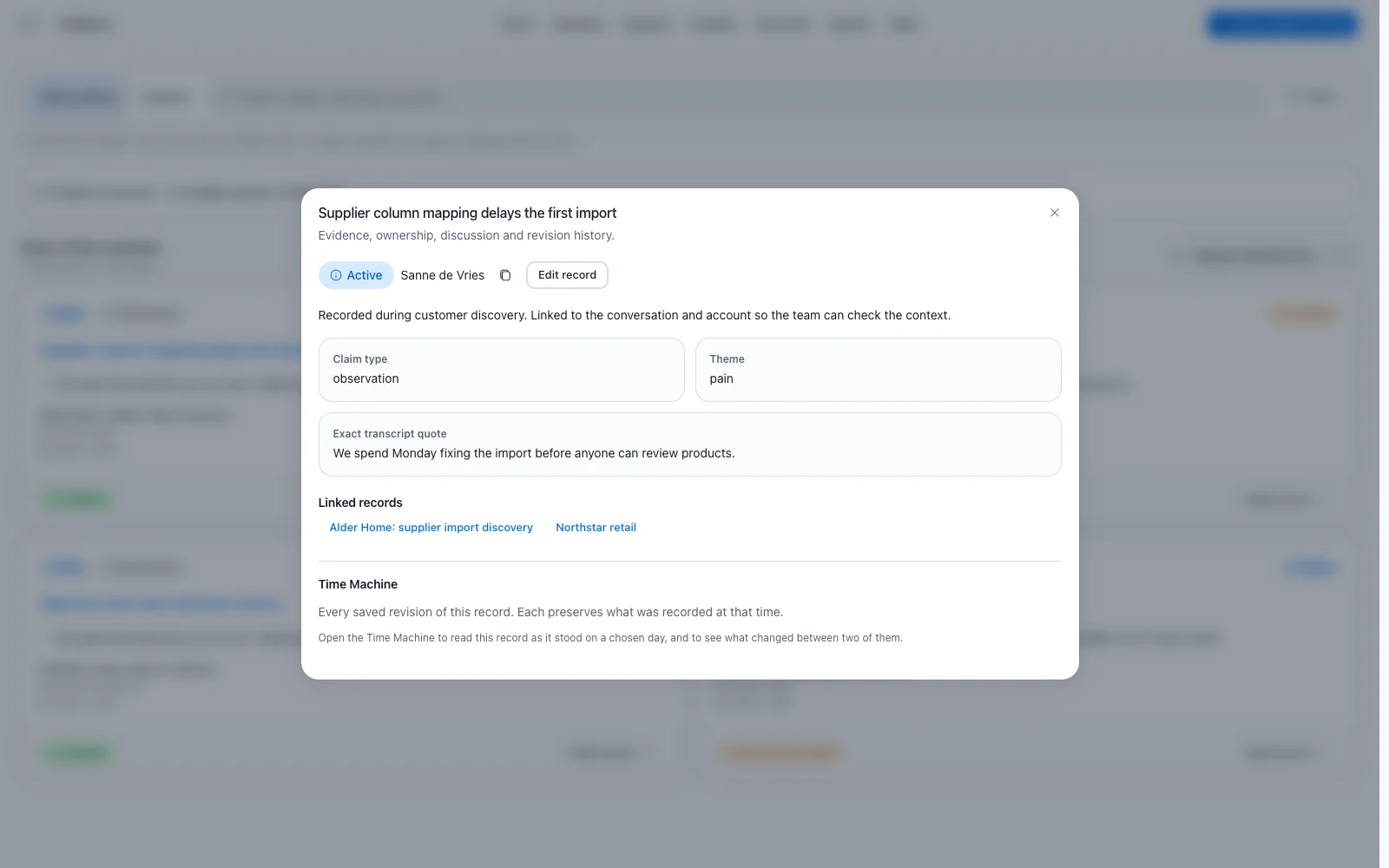
Growth-OS refuses that shape. An insight is not a sentence you typed about a customer. It is a record that carries an exact quote from a meeting transcript in this project, and the save path checks the quote is really there before the record exists.
The rule is checked by the server, not by habit
The quote has to be found in a meeting linked to the same authorized project, and it has to be long enough to be a quotation. The floor is four words and twenty characters, because every transcript contains any single word you might want it to contain.
One owner holds that floor and every path reads it: the record editor, the save service, the extraction verifier and the review screen. A hand-written insight and an approved proposal go through the same gate, so there is no back door where a weaker record gets in.
- The quote must appear in a meeting transcript linked to the same project.
- It must be at least four words and twenty characters after normalization.
- The check runs in the record service, so every writer passes through it.
- If the meeting is edited afterwards, proposals whose span no longer matches read as stale rather than verified.
The model proposes, a person decides
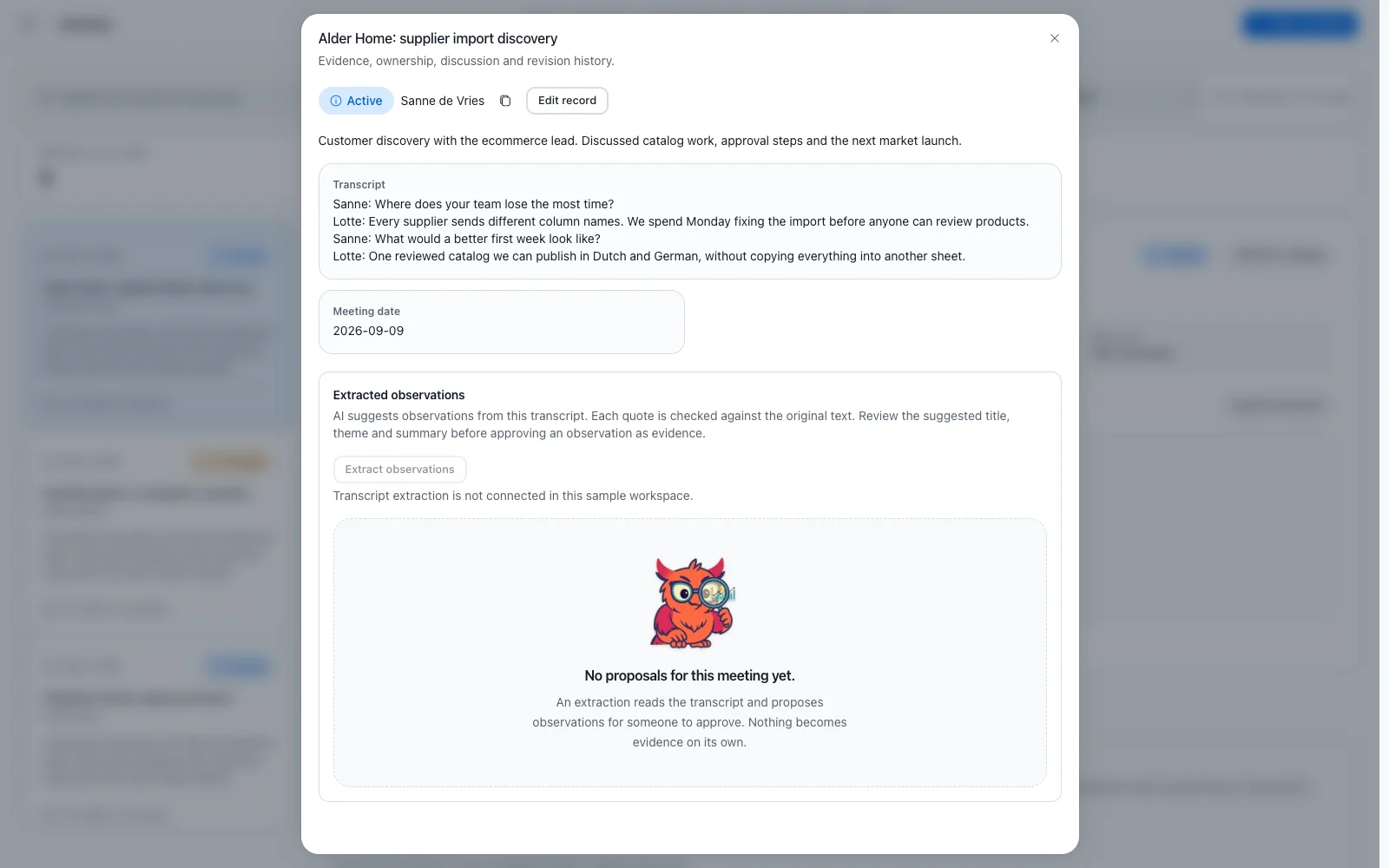
Meeting intelligence queues a transcript for extraction on a durable job. The model proposes observations, each with a character span. The server verifies every span against the transcript before anything is stored: that the span lies inside the transcript, that the text at that span equals the quoted text, and that it clears the length floor.
The quote that gets kept is the transcript slice at the verified span, never the model reproduction of it. An observation whose span cannot be verified is never stored and is counted as a rejection on the run, so a run that produced nothing usable reads as exactly that. A person then approves, edits or rejects each proposal, and a rejection requires a reason.
The explorer opens the count
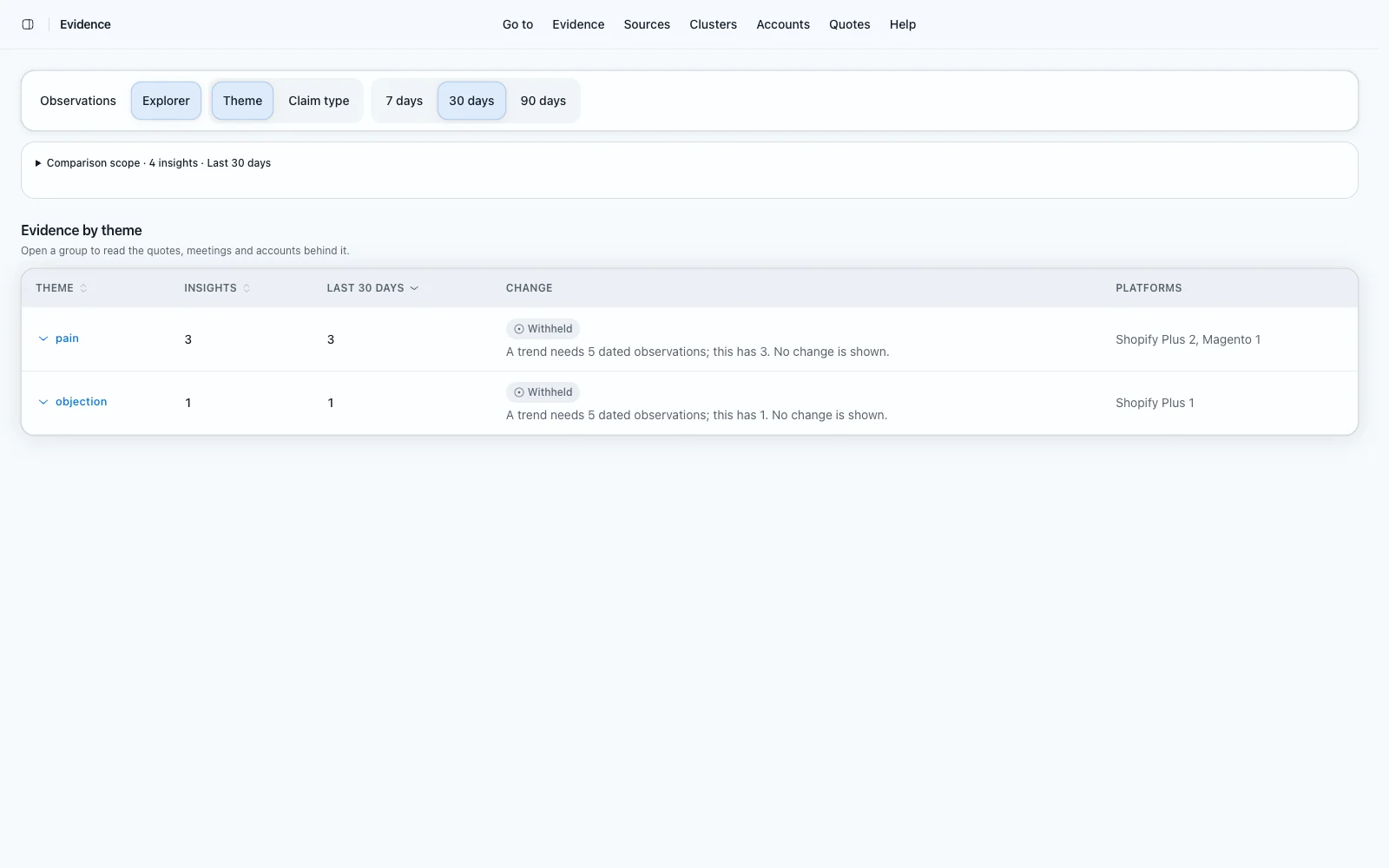
The evidence explorer clusters reviewed evidence by theme and claim type over a trailing window, and every count expands into the accounts and the exact quotes behind it. Dates come from the linked meeting rather than the row timestamp, so a record typed up late does not move a theme into the wrong week. Undated evidence is counted in its own bucket instead of being hidden.
A trend is withheld below a declared floor of five dated observations across both windows, and truncation is reported rather than quietly dropped. That floor is a reporting rule, not a significance test, and the screen says so. It is there to stop two mentions becoming a direction.
“The path from an aggregate back to the sentence somebody actually said should never be broken.”
Where this lives in Growth-OS
Keep reading
Related articles
A week in Growth-OS
A teammate goes Monday to Friday in Growth-OS: the Today page, a meeting you walked into prepared, a decision with a real second option, the roadmap vote, and reading the week back.
What Growth-OS will not do, and why
Campaigns do not send. No source is connected until a person connects it. Fit is a rule comparison. The boundaries are the reason the records stay trustworthy.
Do your next piece of growth work here
Sign in and start on Today. The guides explain each page and what it will not claim.