Decisions that survive the month
The queue sorted by how long a decision has waited, process scaled to what the decision costs, and why an outcome can never touch the process verdict.
WISEPIM Growth-OS
Product
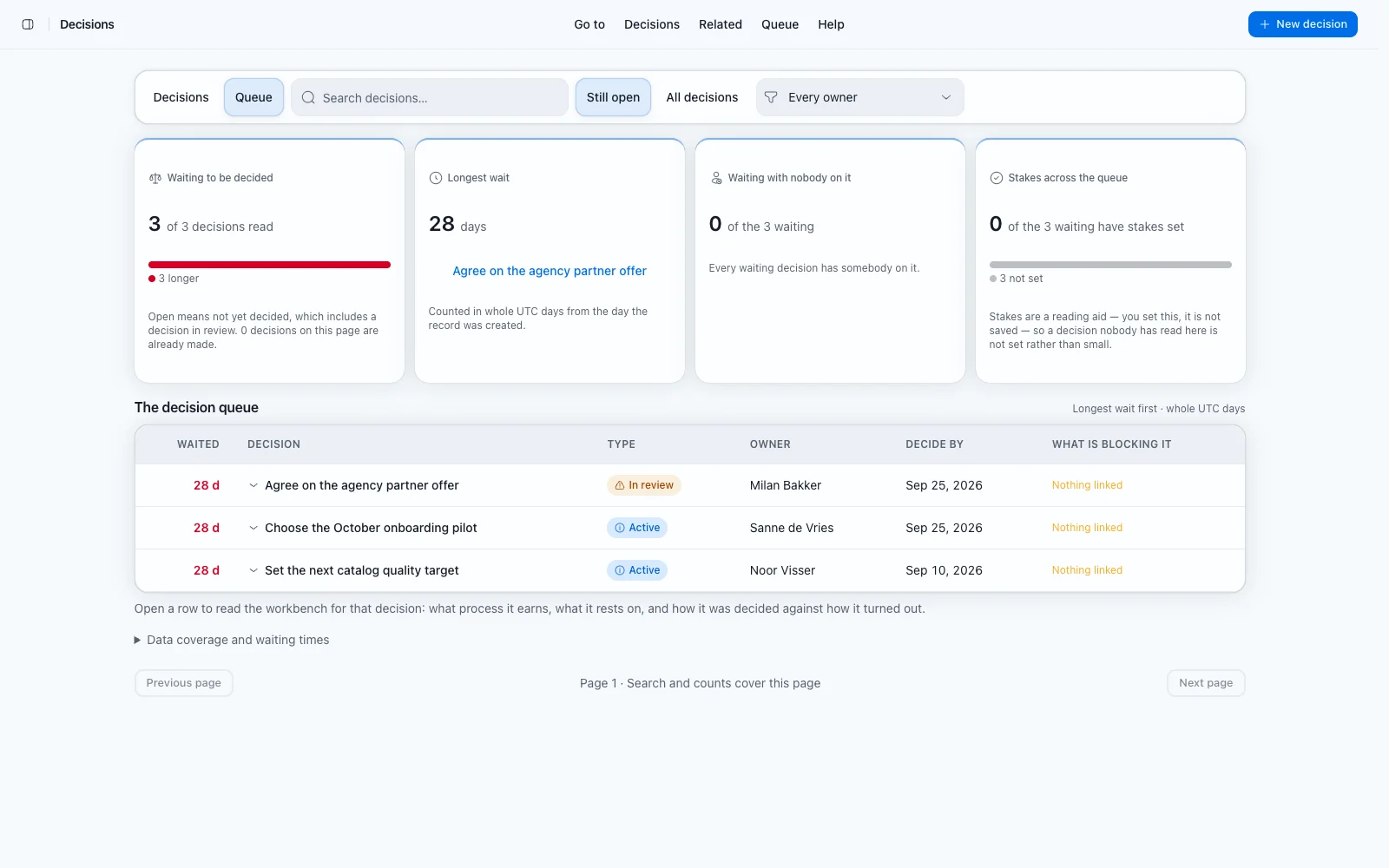
The queue sorts by waiting, not by whoever shouted last
Open decisions are listed longest wait first. Waiting is the measure because an open decision costs something every day nobody makes it, and no other column on the screen shows that cost. Days are counted as whole calendar days in UTC, and ties break on title and then id, so two people reading the queue see the same order.
A decision with no wait to report is reported rather than queued, which keeps the list honest about what it is ranking. The same day count is used on Today, so one decision cannot be six days old on one screen and seven on another.
Process should cost less than the decision it protects
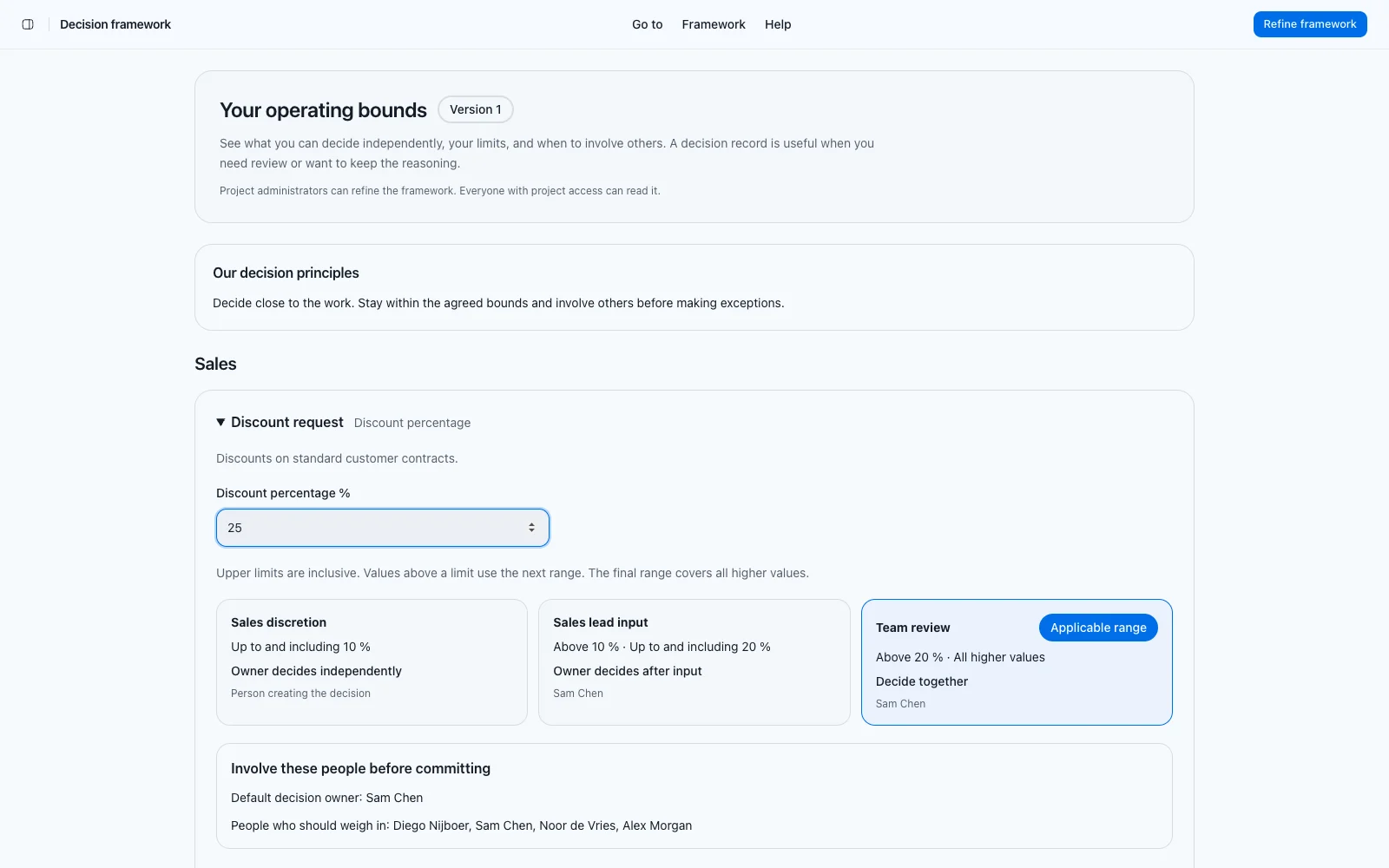
The ceremony ladder reads two things: how big the stakes are, and how hard the choice is to undo. It returns one of three levels and names the tools that level skips, because a screen that quietly left out eight tools would read as though it had considered them.
The mapping is a written table rather than a formula. That is deliberate. You should be able to argue with one cell without reverse engineering arithmetic from the other eight. Neither axis is stored on the record: the screen asks, uses the answer, and does not save it, because guessing reversibility from a title would be invention.
- Just decide: write it down. One line, now, by the owner.
- One page: write it down, alternatives, assumption register, pre-mortem, in one sitting.
- Full review: all ten tools, written down and then read by somebody who did not write it.
The result can never reach the process verdict
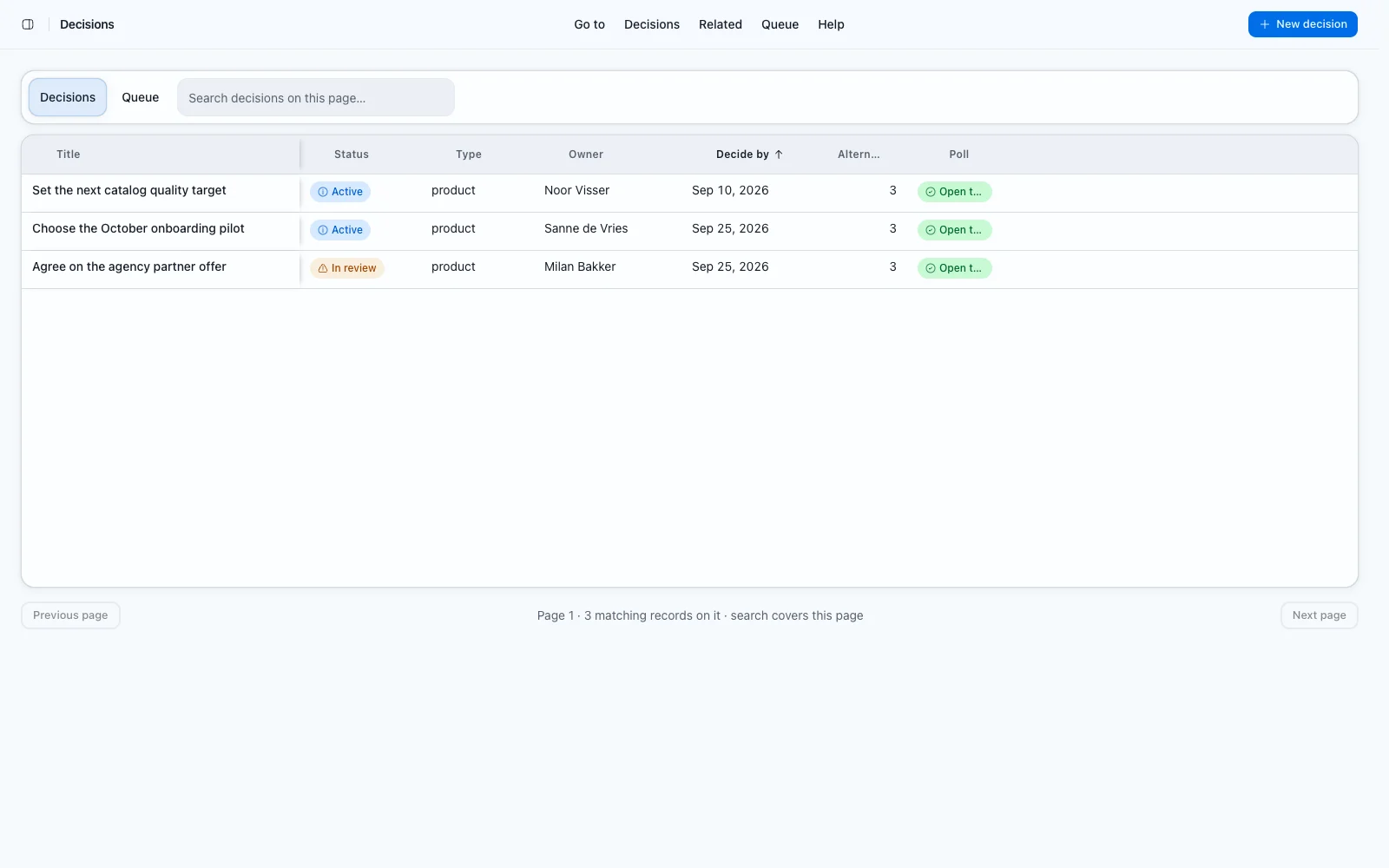
A decision made well on what was known can still turn out badly, and a careless one can still come off. Keeping those apart is the point, so it is built in rather than agreed. The function that assesses the process takes the record as it was and nothing else. The type it reads carries no outcome field, so a result cannot reach the verdict even by accident.
Five checks decide it: two or more alternatives, what was known, what would have changed our mind, how sure we were, and one owner. The verdict is sound, flawed, or cannot tell. Sound describes the process and never claims the choice was right. Cannot tell means the record is blank, which is also why nobody can learn from that decision later. The outcome question is asked separately on the screen and is not saved to any field.
Time Machine keeps the record honest a month later
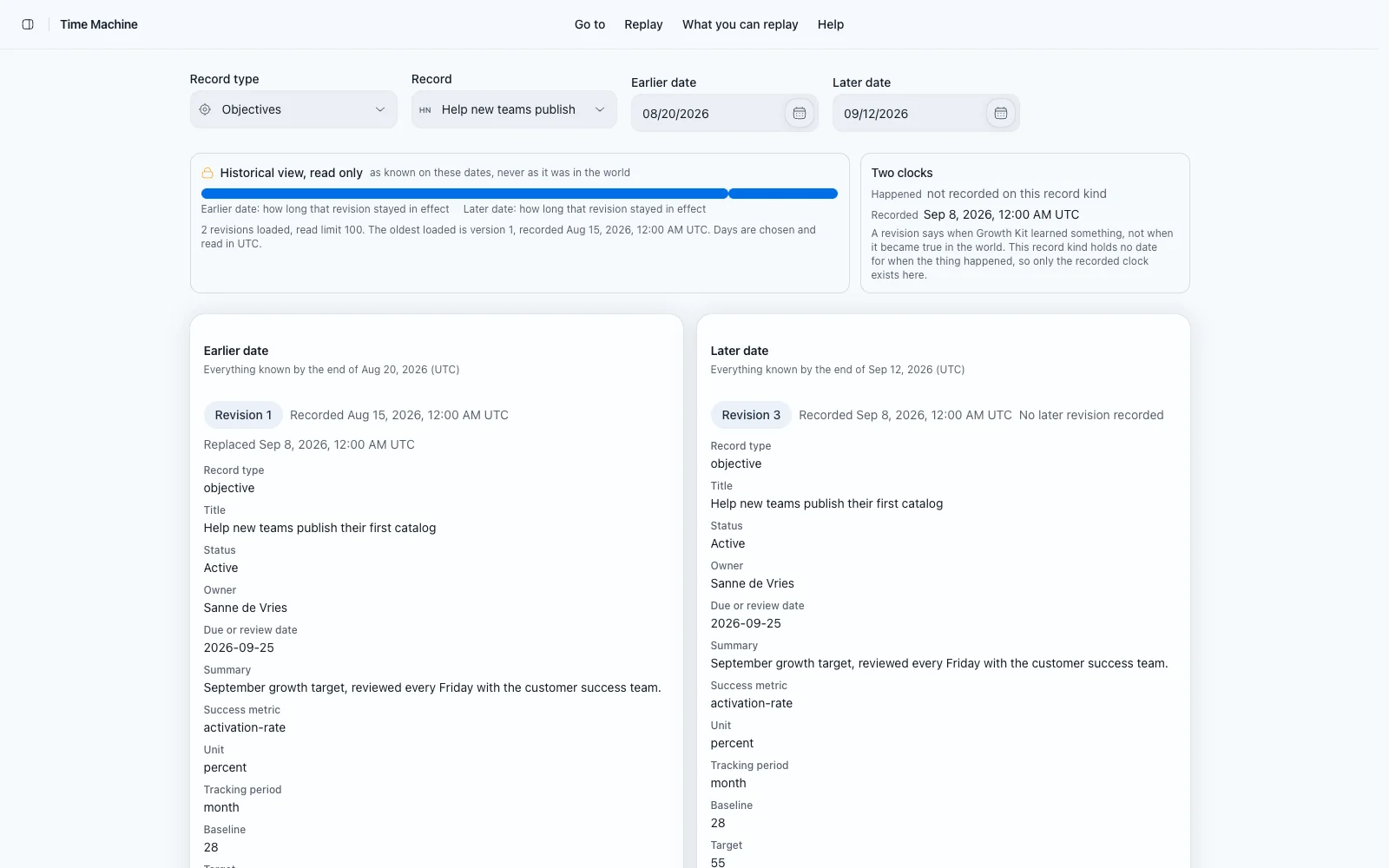
Every save writes a revision snapshot. Time Machine reads a record back as it was recorded at a chosen instant and shows the field-level difference between two instants: changed, added and cleared fields, plus links added and removed, in a fixed order so two runs read the same way.
It is careful about what it cannot prove. Where the stored history cannot answer, it returns an explicit unavailable state. It does not reconstruct independently dated facts inside a record, and it does not pin the external inputs a decision rested on. It reconstructs our records, which is exactly the argument most reviews need.
Where this lives in Growth-OS
Keep reading
Related articles
A week in Growth-OS
A teammate goes Monday to Friday in Growth-OS: the Today page, a meeting you walked into prepared, a decision with a real second option, the roadmap vote, and reading the week back.
What Growth-OS will not do, and why
Campaigns do not send. No source is connected until a person connects it. Fit is a rule comparison. The boundaries are the reason the records stay trustworthy.
Do your next piece of growth work here
Sign in and start on Today. The guides explain each page and what it will not claim.