A blank read as a no
A deal nobody asked about budget is not a deal without budget. Here an unknown criterion is a question for the next call, never a disqualifier.
Vier ICP’s, één telregel, en wie een segment nu bereikt.
Vier ICP’s en het Partnerprofiel staan naast elkaar in één gepubliceerde revisie. Elk bedrijf en elke open deal wordt tegen zijn profiel gescoord met K, G of D per criterium, de telling beslist tussen Sterke fit, Nurture, Low-touch en Stoppen, en wat nog niemand weet wordt de vraag voor het volgende gesprek. Segmenten bewaren wie we willen bereiken, en Leads rangschikt wie een segment vandaag bereikt op dat opgeslagen oordeel.
In de werkruimte
Wat er misgaat als dit werk verspreid staat over spreadsheets, documenten en iemands geheugen.
A deal nobody asked about budget is not a deal without budget. Here an unknown criterion is a question for the next call, never a disqualifier.
Criteria live in published revisions. A change goes through a draft that shows how open deals would move, and every score names the revision it was made under.
One unreadable segment line, and a list meant for mid-market catalogs reaches everybody. Leads names the line, the reason and a hint instead.
In de applicatie
Vastgelegde schermen uit Growth-OS zelf, met voorbeelddata in plaats van onze eigen records.
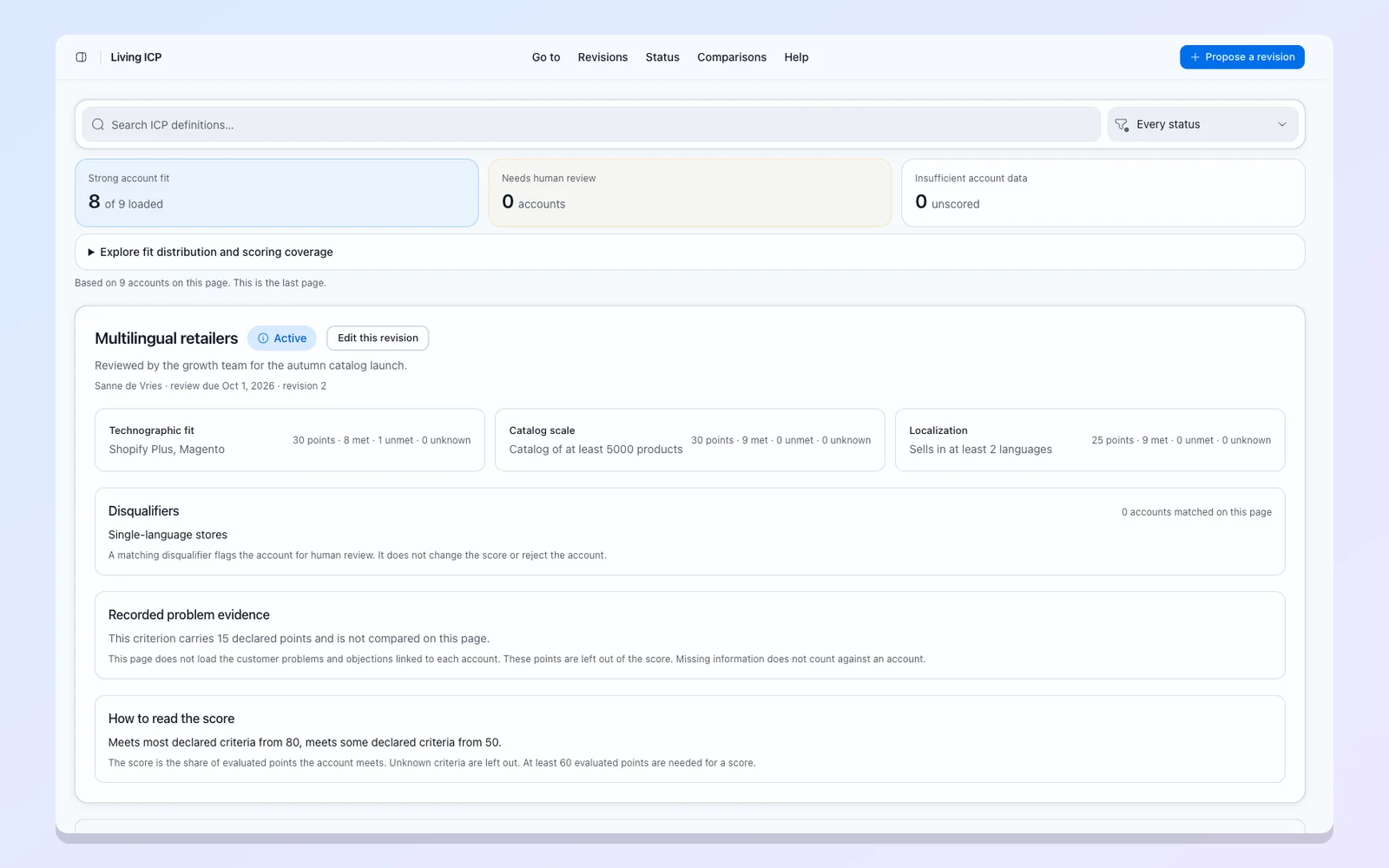
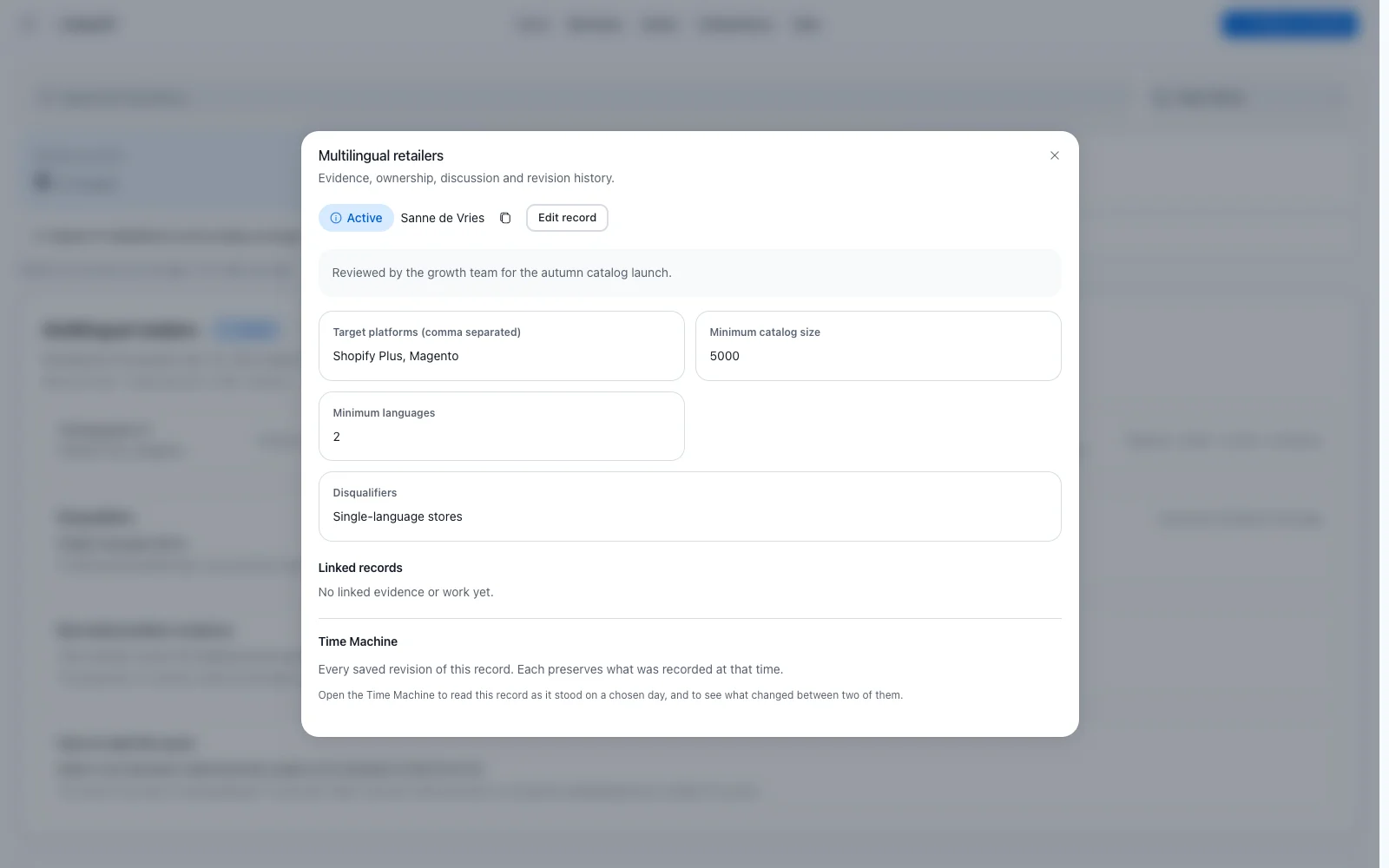
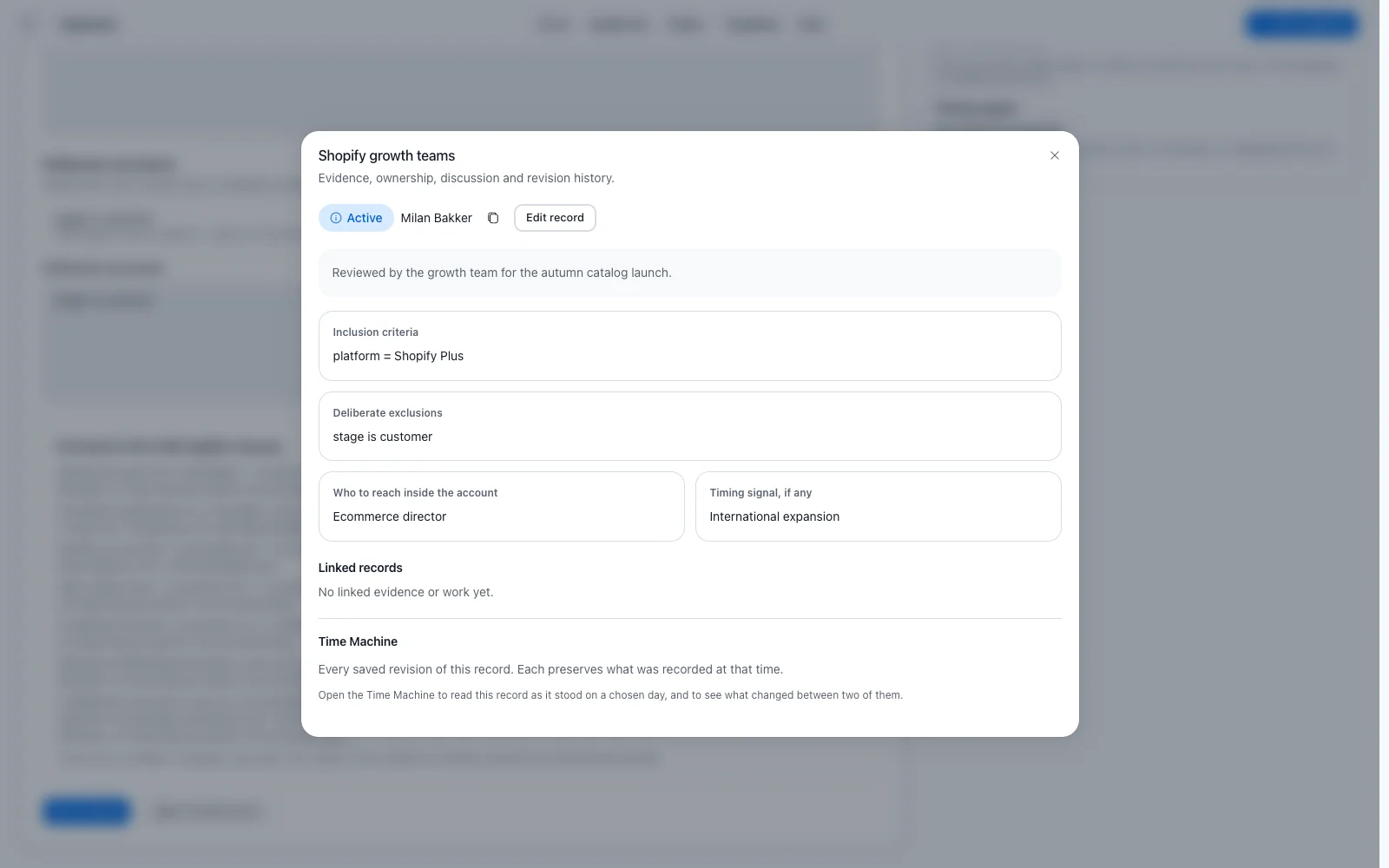
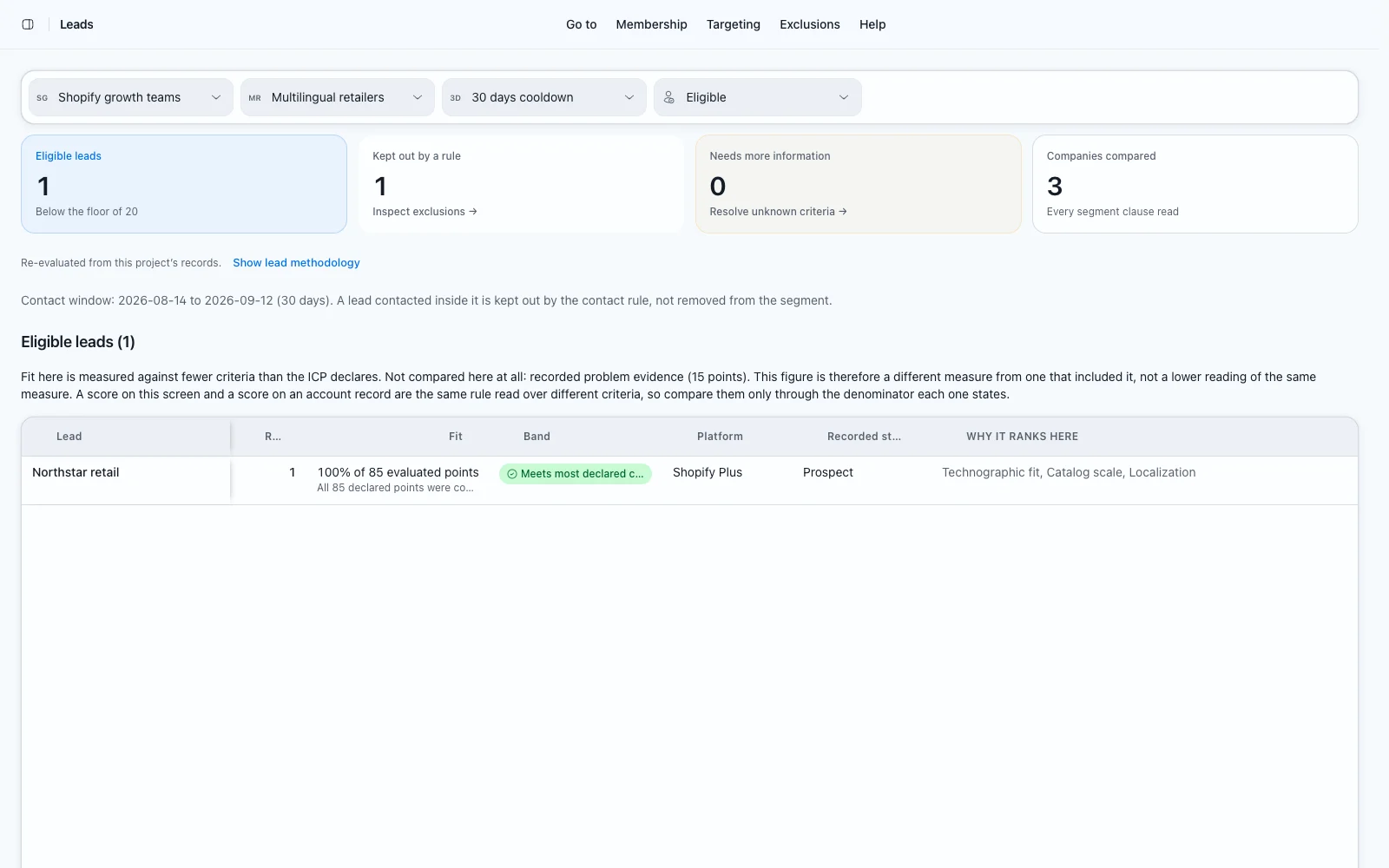
Van leeg record tot iets waar je op kunt handelen, in de volgorde waarin je het doet.
Publish the criteria set
An admin publishes the WISEPIM criteria set, four ICPs and the Partner profile as revision 1, and scores the open pipeline once.
Read the scorecard on a deal
The outcome and status, the K, G and D count, the path to Strong fit and the questions to ask on the next call, in the CRM window.
Write the segment as clauses
One per line: field, comparator, value. Deliberate exclusions go in their own field rather than hiding inside the inclusion text.
Open Leads
Pick the segment, narrow to one profile if you want, and set the contact window to seven, thirty or ninety days. Eligible companies rank by their stored verdict.
Kernpunten
Every criterion reads K, G, D or unknown, with its evidence. Enough K and no D is a Strong fit, and a hard requirement at D stops the deal whatever else scores K.
A criterion nobody has evidence for is never a D. It keeps the verdict provisional and lands under Ask on the next call, hard requirements first.
On the 1st, Growth-OS suggests changes from what happened: D’s on deals that were won after all, boundaries that won and lost deals straddle, overrides that keep repeating. An admin accepts or rejects each one.
Eerlijke grenzen
Qualification is a rule verdict against the published criteria. It is not trained or predictive; an AI judgement only fills a criterion the rules leave unknown, and the scorecard says so.
Coverage describes the accounts you recorded, never the market. Forty account records produce a funnel about forty companies.
Deze pagina's delen records met deze, dus wat je hier schrijft komt daar terug.
De pagina opent met de records van dit project. De ingebouwde gids beschrijft elk veld.